Back to portfolio Concept in development

Narrative and systems design

Carrying the Fire,
Casting the Light

An interactive historical narrative adventure

In 2050, a history assignment asks a question the records cannot answer. Two students are sent to find out what Dillard's people carried that never made it into the file.
Narrative design in progress Unity prototype planned Concept art complete

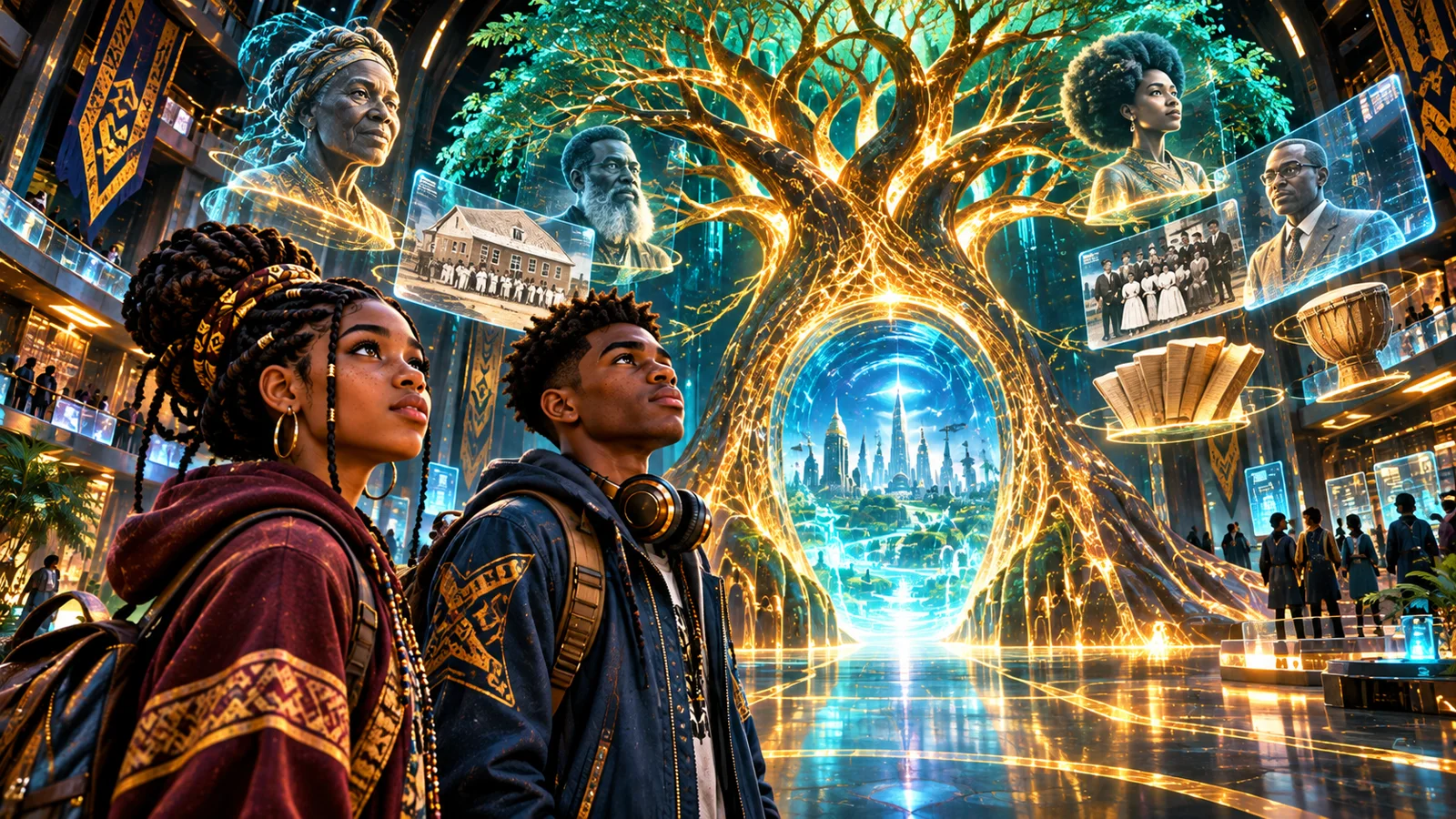
Concept art: two students stand before an immense tree of golden light in a vaulted library, ancestral figures projected among its branches and a luminous city visible through a portal at its roots.
Concept art, not in-game footage

The world

Somewhere between the classroom and the archive, the library stopped being only a library.

  • The command is GO BACK. It moves you out of the 2050 classroom and into a historical world. Nothing in the course catalogue explains what does the carrying.
  • Dr. Brown keeps the Books of Knowledge. She is the griot of the library and its guardian. Whether the Books are physical, digital, symbolic or something else is not a question she answers early.
  • Finding the answer is not how you get home. Returning requires GET IT: showing that you understood what you found, and who it belonged to. Evidence alone will not open the door.
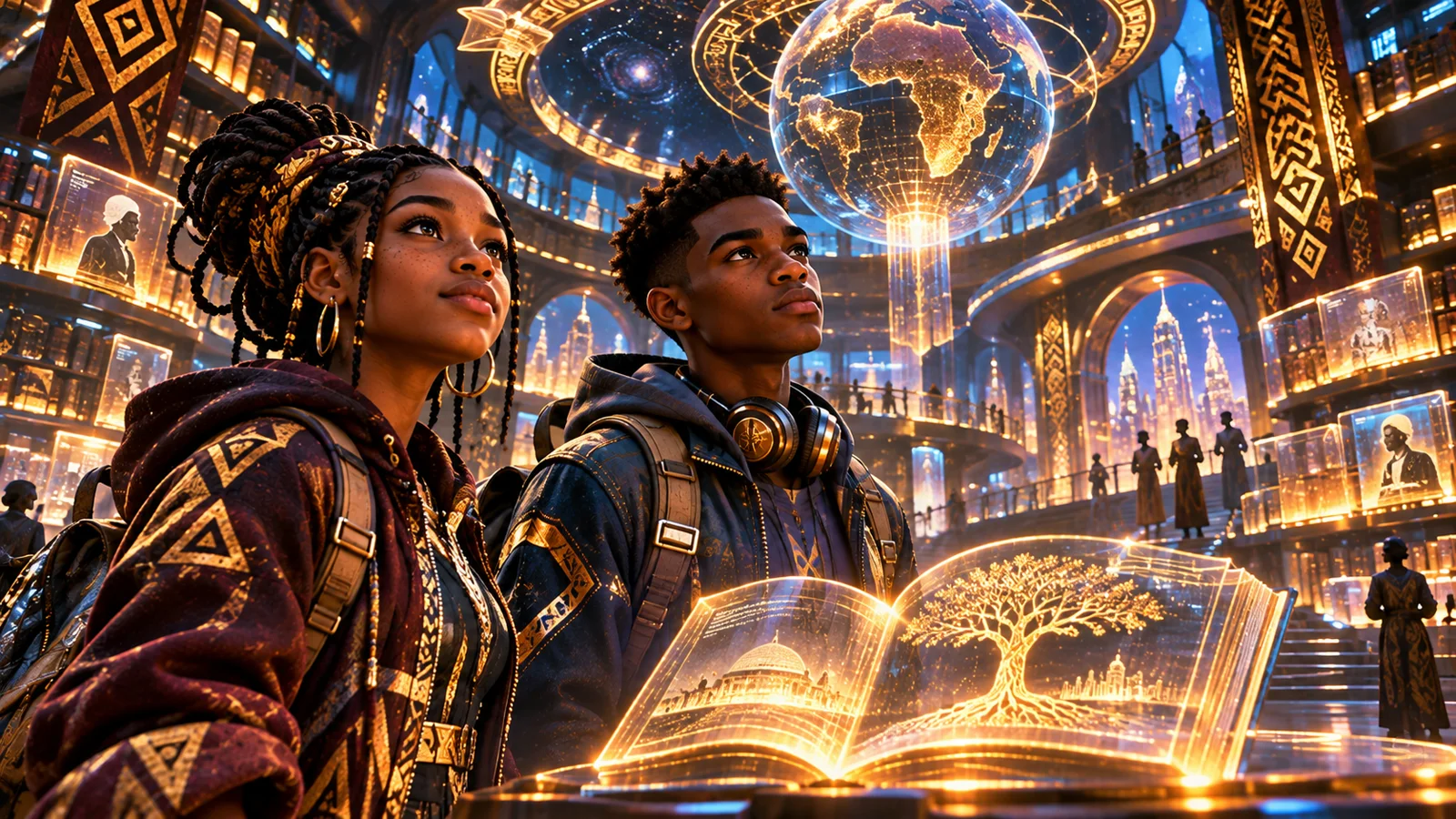
Concept art: the interior of a vast futuristic library, shelves of luminous volumes rising around a holographic globe, with a glowing open book in the foreground.
The library, command station

Space one

The virtual classroom

2050. Where the assignment is set and where the questions are first asked out loud.

Space two

The library, command station

The hub between journeys. Artifacts are catalogued here, the evidence journal lives here, and the rules of the place reveal themselves slowly.

Space three

The historical worlds

Where GO BACK takes you. Research-informed, fictionalized, and built to be investigated rather than toured.


Two players, two paths
They can be played apart. They are designed to meet.

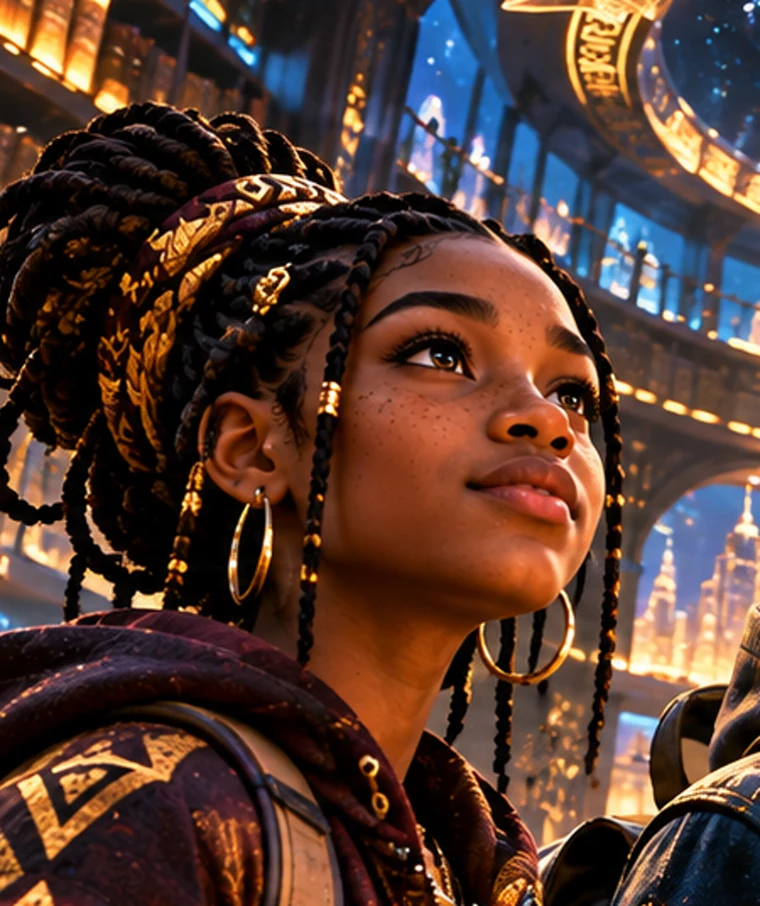
Concept art: Mary, a young woman with braided hair wrapped in patterned cloth and gold beads, looking upward in the luminous library.

Playable

Mary, the seeker

Reads artifacts, stories and lived experience, and follows meaning where Zebedee follows people. Her route through the first quest runs independently of his.

Abilities still in design
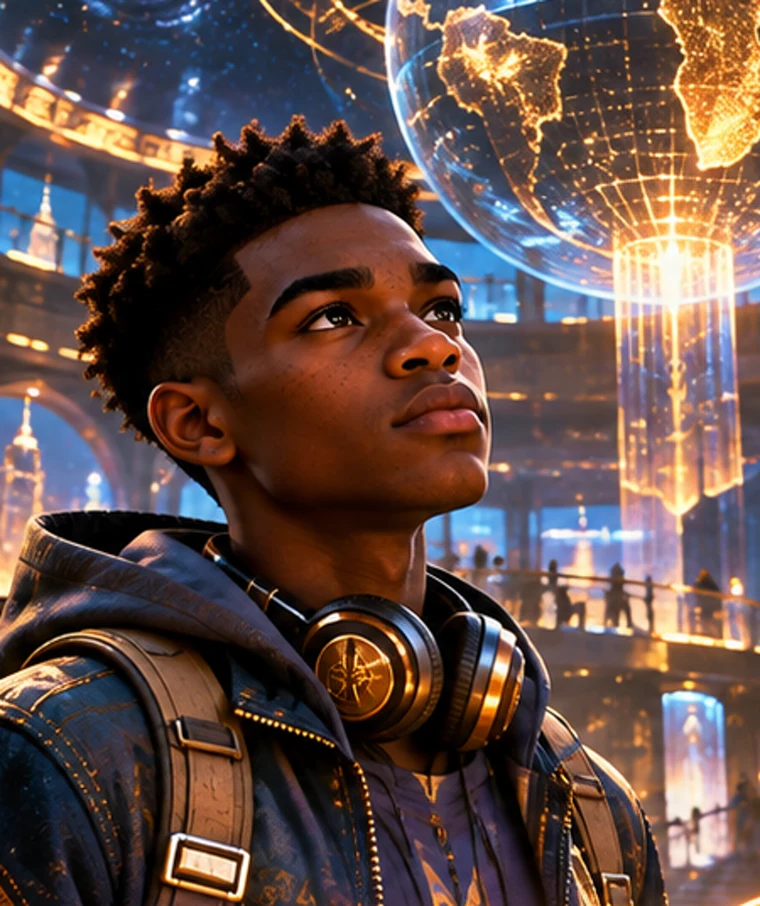
Concept art: Zebedee, a young man in a patterned jacket with headphones around his neck, looking up at a holographic globe.

Playable

Zebedee, the connector

Follows people, places and relationships. His ability surfaces connections between entries in a record. It shows relationships, not verified facts, and the difference is the point.

Network of Hands


The loop

Four verbs, and the third one is the hard one.

GO BACKLeave the classroom. Arrive somewhere that has not been summarised for you.
DISCOVERRead, ask, inspect. Record what you find and where it came from.
GET ITDemonstrate understanding, not collection. This is what ends a quest.
CARRY FORWARDWhat you understood goes with you. So does what you failed to ask.

First quest

The School That Remembered

Four scenes from the opening quest, in order. Each one is a concept illustration of a designed beat, not a screenshot of a built level.
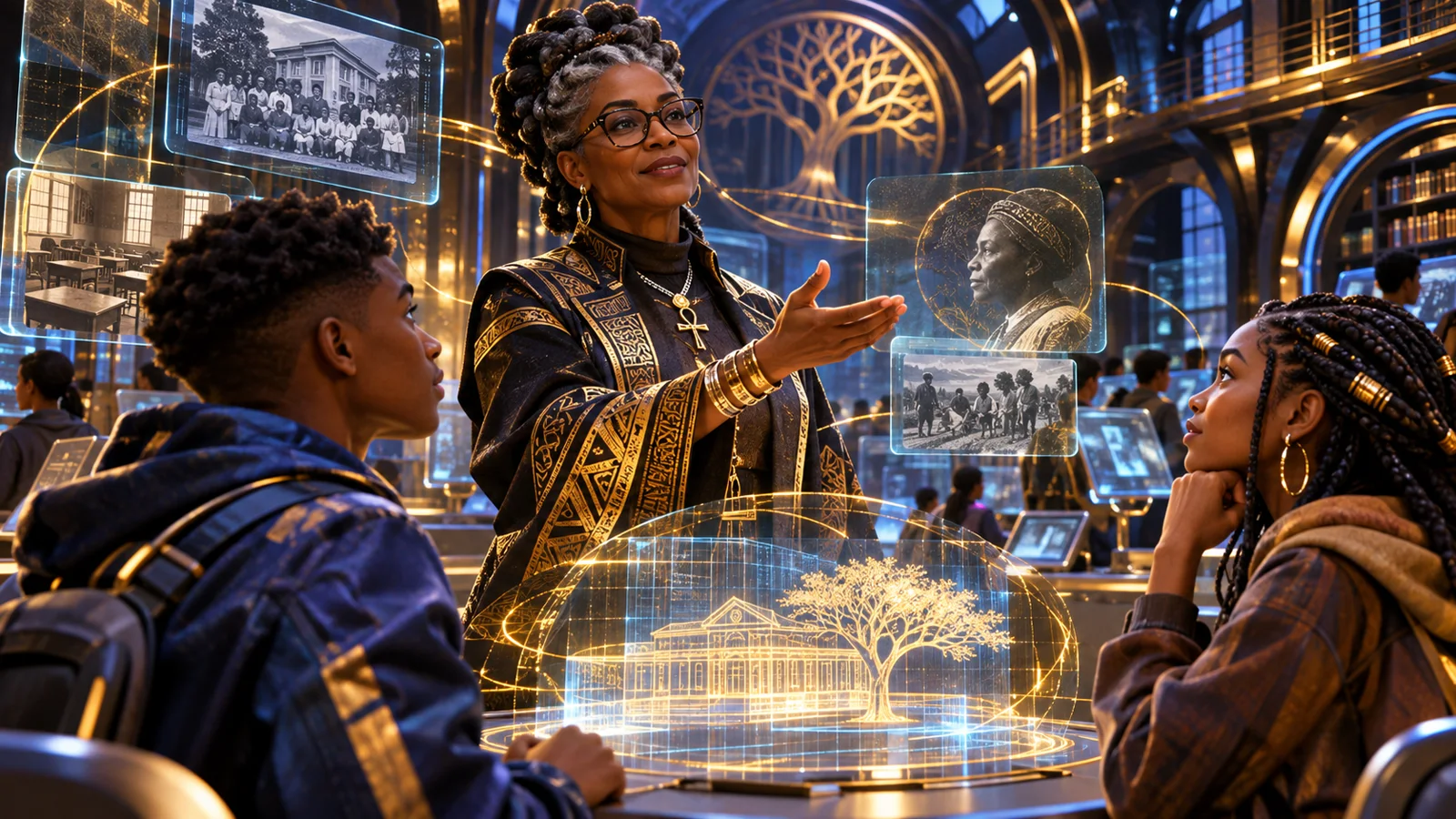
Concept art: Dr. Brown, in patterned robes, presents a glowing projection of a schoolhouse and a tree to two seated students in a futuristic classroom.
12050

The Assignment

Dr. Brown sets the question: find out what Dillard's people carried beyond the classroom. Her command opens the first historical passage.
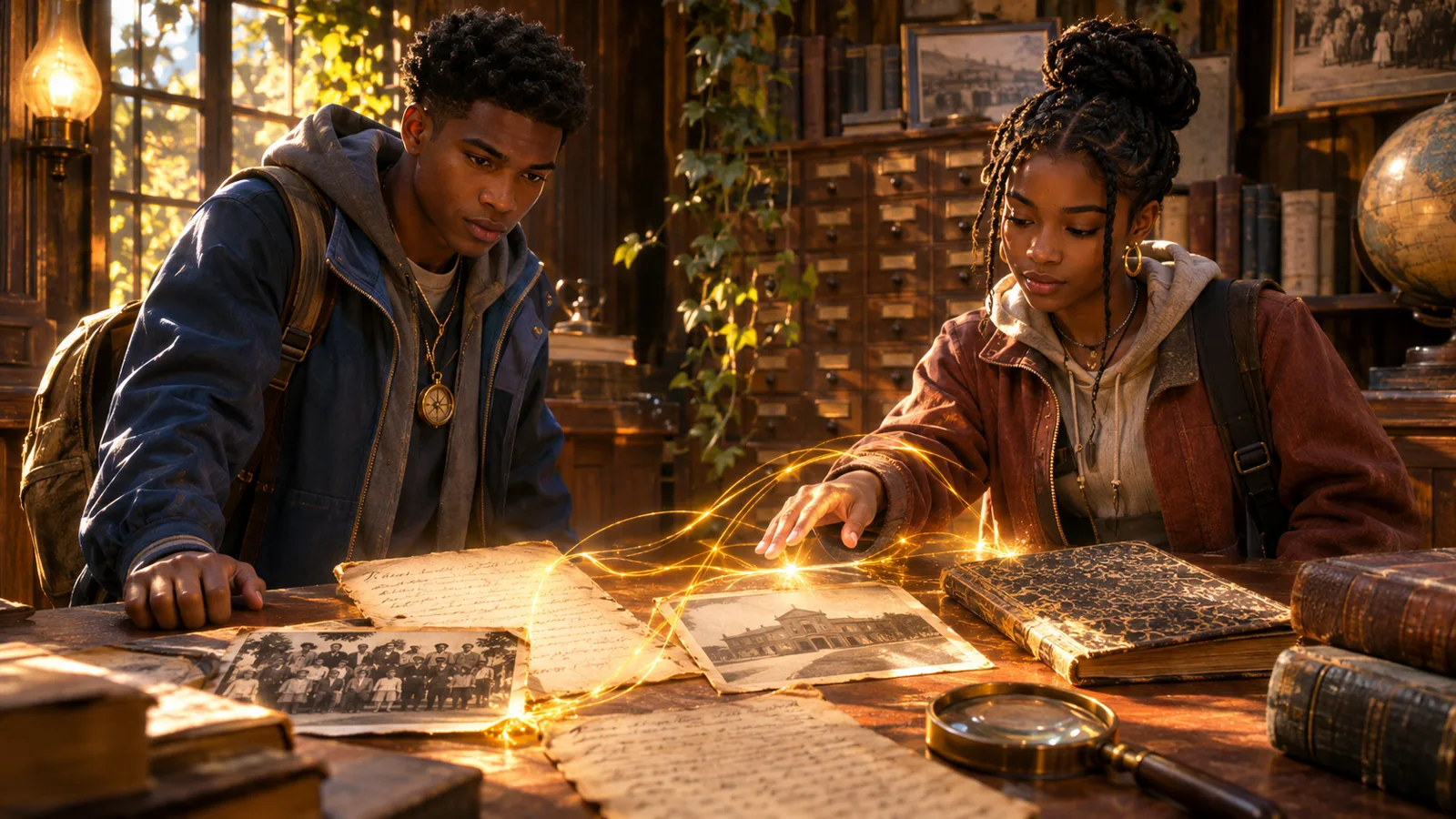
Concept art: two students examine handwritten documents and photographs on a lamplit archive table.
2Historical world

The Handwritten Letter

A letter from the archive shows families and neighbours sustaining children's education well outside formal instruction.

The letter and its author are fictional placeholders.
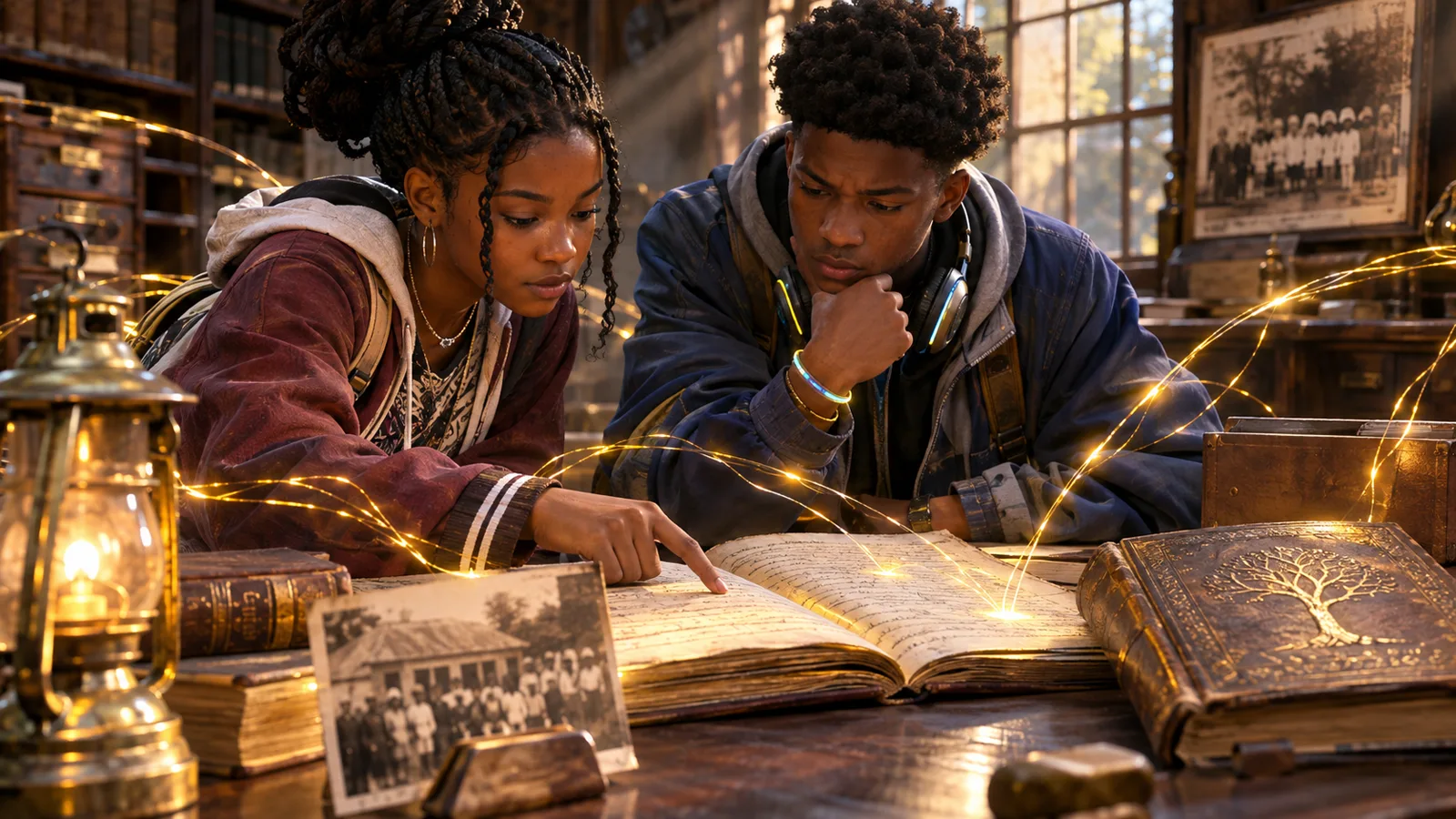
Concept art: two students lean over an open ledger threaded with lines of golden light, beside a framed class photograph.
3Historical world

The Work of Many Hands

A community notebook lists what people gave: food, repairs, childcare, books, transport. The entries are short. The structure behind them is not.

The notebook is fictional.
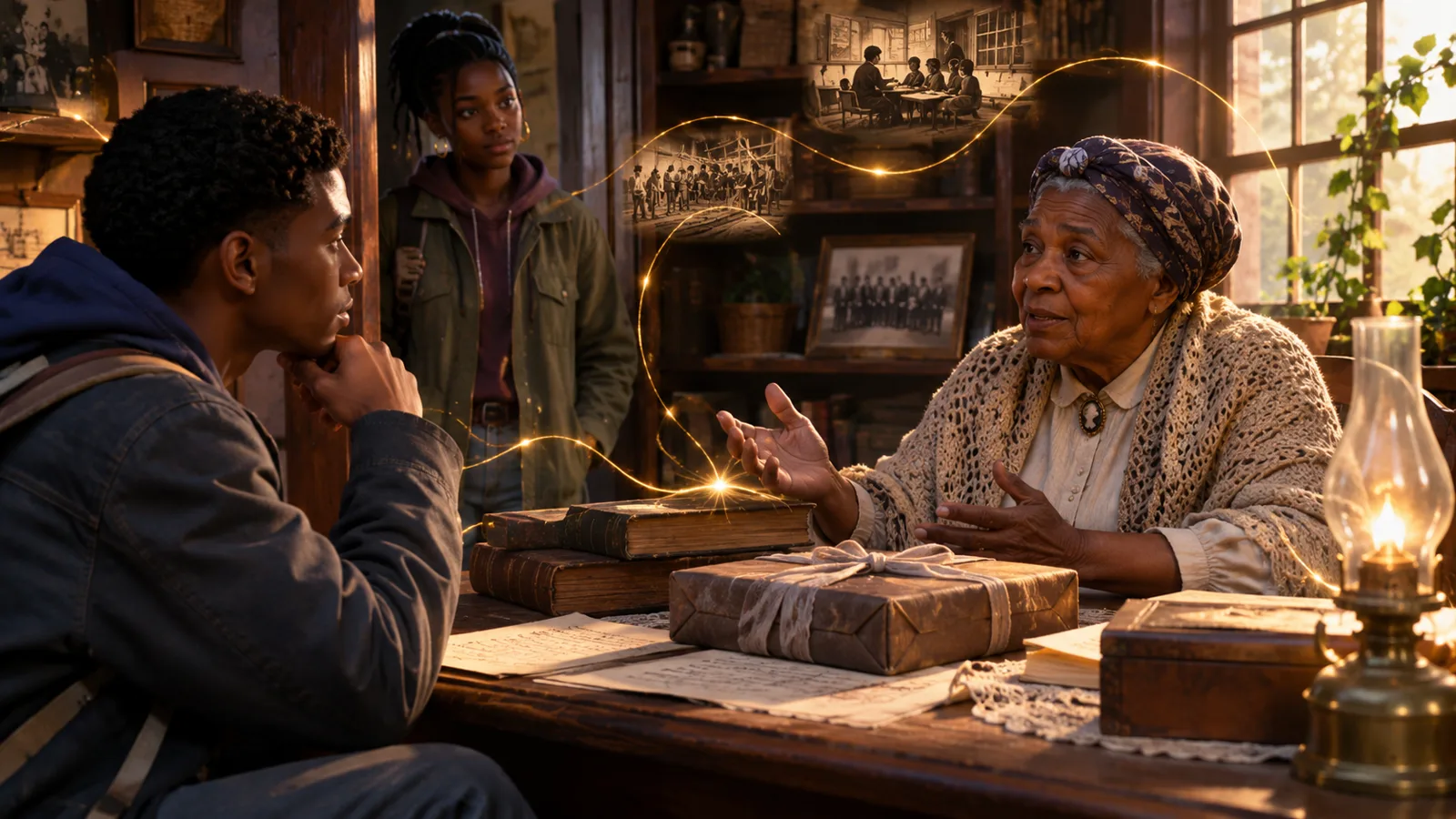
Concept art: two students sit with an elder at a table of books and papers, threads of light running between them.
4Historical world

The People Behind the Entries

Names in a margin become a conversation, and the conversation has limits. Remembering turns out to require consent, corroboration, and knowing what is not yours to pass on.

Atmospheric concept art. The witness is a fictional character.


Systems and mechanics design
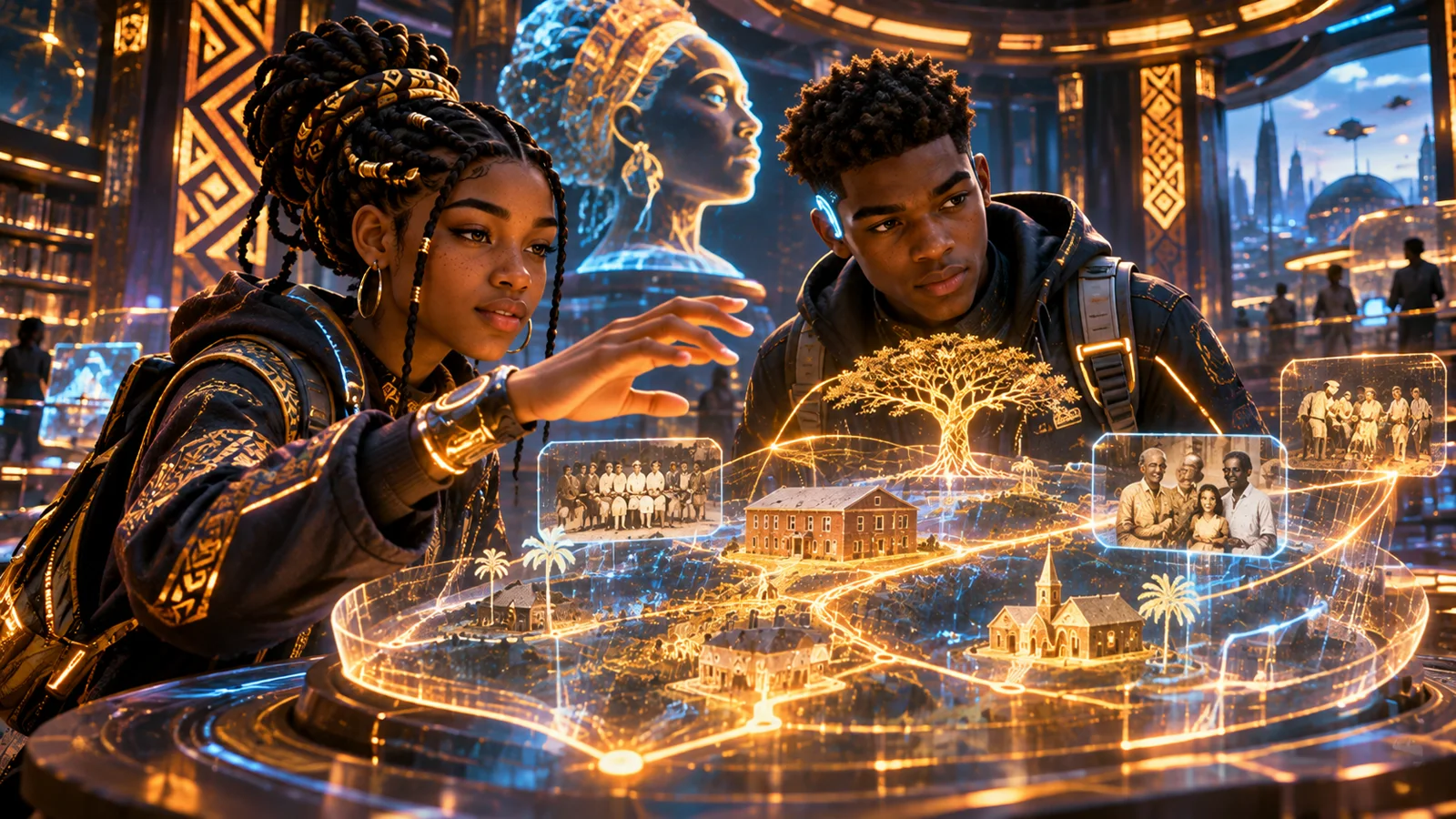
Abilities built as research verbs, not powers.

Concept art: Mary reaches into a holographic table map where a tree of golden light links buildings, routes and archival photographs.
The Network of Hands, shown as concept art rather than as interface design.
  • Network of HandsReveals relationships between entries in a record: who recurs, who connects to whom, what clusters. It deliberately does not assert that a connection is true.
  • Listening GiftOpens testimony that inspection alone will not reach, and is gated on how the player has treated people up to that point.
  • Evidence journalClaims are recorded separately from corroboration, so the player can see which of their beliefs are actually supported.
  • Relationship statesDialogue branches carry forward. Who will speak to you later is a consequence of how you asked earlier.
  • Inspectable objectsArtifacts can be examined, compared and catalogued into the hub rather than simply collected.
  • ConvergenceZebedee and Mary hold different pieces. The design question under the whole quest is what should happen when their paths meet.

The quest does not end when you have the artifact. It ends when you can say what it meant and who it belonged to.


Research grounding

The mechanics come out of the research, not the other way round.

The game extends doctoral work on literate identity and an ongoing postdoctoral project on intergenerational memory. Every design decision above traces to one of these.

Sankofa Multimodal Media ProficiencyThe framing that treats recovering, interpreting and passing on knowledge as one literacy rather than three skills.
Community cultural wealthWhy the community notebook is a mechanic. The resources a community actually holds are rarely the ones a record was designed to capture.
Literate identityFrom the dissertation. What it means to see yourself as someone who reads, interprets and is entitled to an archive.
Responsible interpretationConsent, corroboration and the limits of testimony, built into the quest's completion condition rather than bolted on as a content warning.
Verification registerEvery historical claim in the working document carries its own status: verified, research-informed, or fictional. Nothing reaches a player unlabelled.

The future is not disconnected from the past. It is shaped by what communities remember, protect, and pass forward.

Development status

Warm archival amber against deep navy.

A single visual rule runs through every scene: knowledge is warm and it travels as light. Threads connect what the record separated.

  • Complete
    Concept illustrationScene boards for the first quest, generated to a directed art brief and selected for a consistent visual language.
  • In progress
    Narrative designQuest structure, ability design, dialogue branching, and the convergence question.
  • Planned
    Unity desktop prototypeOne library hub, one compact historical archive, branching dialogue, inspectable objects, the evidence journal, relationship states, and a single stylized effect.
  • Exploration
    Expanded worlds, AR and VRLonger-term, and dependent on what the prototype proves.

Research foundation

Research Foundation & Acknowledgments

Carrying the Fire, Casting the Light is an original Afrofuturist game concept developed from the doctoral research of Dr. Mistoria Brown, titled The Wealth We Carry: Mapping Literate Identity Across Affinity Spaces. Her dissertation received the 2026 Dissertation of the Year Award from the Department of Teaching and Learning at the University of Miami.

The research informing this game concept also received Proposal of the Year recognition at the Sankofa Research Intensive at Wayne State University, as well as Summer 2025 grant funding from the Center for Black Studies to support initial research.

Development status. This game is currently in the conceptual development and research phase. Full funding is being sought to support further research, game development, and implementation.